
Permits
Dust Control Rules and Your Job Site in Maricopa
A tenth of an acre is about 4,400 square feet. That is a large patio, not a subdivision — and it is the threshold that triggers a county dust permit.
The rule most people find out about late
If you are planning work in Maricopa that disturbs ground rather than just filling a container, there is a county requirement worth knowing before you start rather than after somebody stops by.
That is Pinal County Air Quality, and the threshold is a great deal lower than most people assume.
To be clear about what this is and is not: it is a rule about disturbing ground. Putting a container on your driveway and filling it with cabinets does not trigger anything. Grading a lot, scraping a yard down to dirt, trenching for utilities or clearing a pad does.
What a tenth of an acre actually looks like
An acre is 43,560 square feet, so a tenth of an acre is about 4,356 square feet.
Put in terms of jobs we actually see around Maricopa:
- A back yard being scraped for a full landscape rebuild — often over the line
- A pad graded for a large shop or garage — usually over the line
- Trenching a long utility run across an acreage property — can be over the line
- A pool excavation with spoil stockpiled alongside — frequently over the line
- A single driveway replacement — usually under
- A bathroom gut with a container on the drive — not applicable at all
On a typical Maricopa lot, a whole-yard conversion is a genuine candidate. On acreage out toward Hidden Valley or Thunderbird Farms, almost any real project clears it.
Why the rules here are stricter than elsewhere
This is not generic environmental boilerplate. It is a specific regulatory situation that has got worse rather than better.
In 2012 the EPA designated a large portion of Pinal County a moderate nonattainment area for particulate matter — PM10 — after monitors recorded violations of the federal air quality standard.
The area is known as the West Pinal PM10 Nonattainment Area, and Maricopa sits inside it. The county's stated reasoning is direct: ground disturbance from construction activity, general earthmoving and windy conditions all put particulate matter into the air, and the construction rules were needed to achieve emission reductions.
So a contractor arriving from outside the region and assuming Arizona is relaxed about this has it exactly backwards.
What fugitive dust actually means
The county's definition is broader than most people expect. Fugitive dust is particles lifted into the air by man-made and natural activity — the movement of soil, vehicles, equipment, blasting, and plain wind.
The "and wind" part matters. A stockpile that behaves perfectly while nobody is touching it is still a source when a monsoon outflow arrives at fifty miles an hour. That is the scenario the rules are written around, and it is why leaving a scraped lot untreated over a summer weekend is a genuine risk.
Which permit, and how to find out
There is more than one dust permit, and which one applies depends on where the project is rather than what it is.
The Air Quality Department publishes a map viewer keyed to parcel numbers. You enter your parcel number without dashes, the map zooms to the parcel, and the color coding tells you which area you are in and which application to download.
The department recommends applying online rather than on paper. If you would rather do it in person, the office is at 85 N Florence Street in Florence — and that is Florence, Arizona, the Pinal County seat, roughly forty minutes east of Maricopa.
Pinal County Air Quality: (520) 866-6929.
Two administrative points worth noting. The rules sit in the Pinal County Air Quality Control District Code, Chapter 4, under Article 3 for construction sites generally and Article 7 for construction sites in nonattainment areas — which is the one that applies here. And a dust control registration expires one year from the date of issuance, so a long project needs renewing.
The training requirement
Easy to miss, and it catches people out.
It is not enough to hold the permit. The worksite has to have completed the required training as well. If you are a homeowner acting as your own general contractor on a substantial project, that obligation is yours, not somebody else's.
Practical control measures
The county's expectation is that reasonable precautions are taken. In practice that means:
- Water. Having a water truck available is the standard measure on any real site. On smaller jobs a hose and a schedule can be enough — the point is that it actually happens.
- Chemical stabiliser. Treating dirt areas with a stabiliser holds a surface that water alone will not, particularly through summer.
- Restricting access. Keeping vehicles and people off unstabilised surfaces removes the disturbance rather than managing it.
- Stabilising haul routes. Vehicle movement over a dirt access track is a dust source in its own right, which matters on the acreage properties where the drive is a quarter of a mile of decomposed granite.
- Managing stockpiles. Cover or treat them. Wind does not care that you were not working that day.
None of this is exotic. It is mostly about planning for it rather than improvising when somebody complains.
Where the container fits in
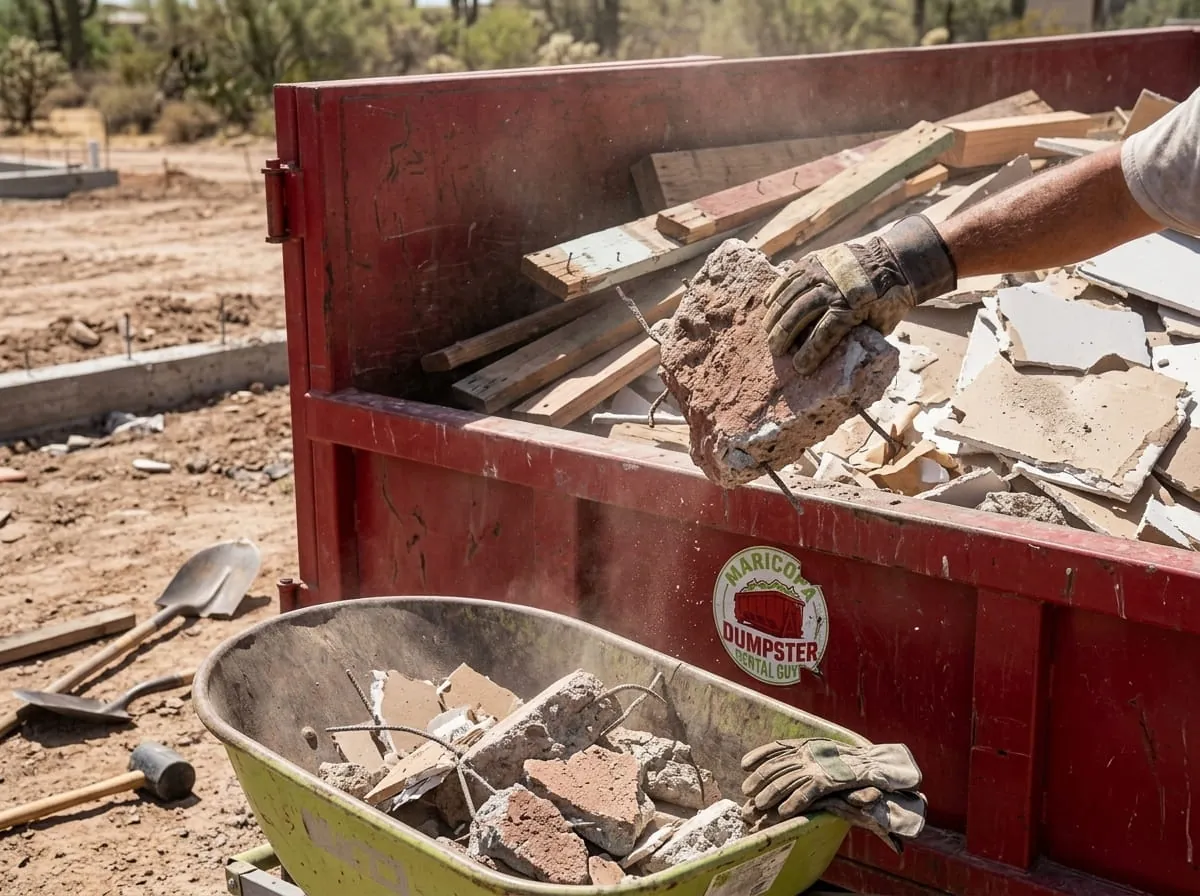
Plainly: a roll-off container is not a dust control measure and we will not pretend otherwise. But how you handle debris does affect how much dust a site produces.
- Get material off the ground and into the container rather than into a pile that sits for a fortnight. A loose heap of demolition rubble on a dirt lot is a dust source; the same material in a steel box is not.
- Load it damp if you are breaking out concrete, block or stucco. It cuts the airborne fraction dramatically at the moment it is worst.
- Keep the container covered between sessions when it holds fine material. Ours can be tarped — ask.
- Schedule swaps so the site never accumulates loose debris, which on a phased job is usually cheaper than one long placement anyway.
And if the container itself has to sit on unstabilised ground, tell us. Boards go down as standard, but on a dirt pad we would rather discuss the placement than have a truck cut ruts across a surface somebody has just paid to stabilise.
Rules change and thresholds get revised. Everything above reflects Pinal County Air Quality's published position at the time of writing. Confirm current requirements on (520) 866-6929 before relying on them for a specific project — and note that this is Pinal County, not Maricopa County, which operates its own separate air quality program.
Need a container in Maricopa?
Call and describe the job. Three minutes on the phone gets you a size recommendation, a flat rate and a delivery window — and we will tell you if a smaller, cheaper container is the right answer.
Call (520) 217-7573