
Construction
Where Construction Debris Actually Goes Around Maricopa
A fast-building city in a Serious nonattainment area. How you handle debris here is a compliance question as well as a cost one.
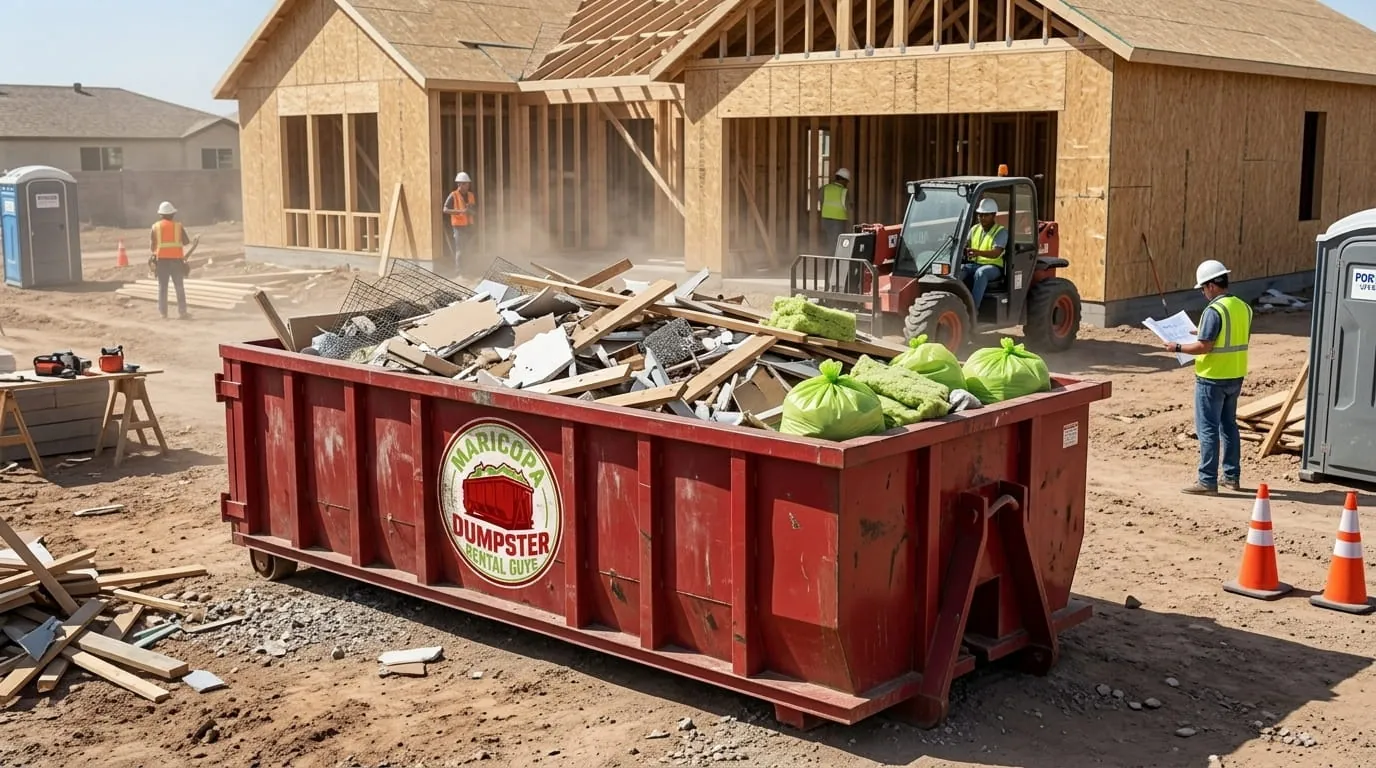
A city still being built
Maricopa has grown from a small farming crossroads into a city of tens of thousands in about two decades, and it is still going. Whole communities on the northern edge are part-built, and the older subdivisions from the first growth wave are now hitting their first serious renovation cycle.
That combination gives us two quite different construction customers in the same streets: builders working new phases, and homeowners renovating twenty-year-old houses. They need different scheduling and different container sizes, and Tortosa is a good example of both happening at once.
Why municipal collection does not fit
City refuse service here is mandatory — occupied residential properties must have it and cannot opt out. But it is a household waste service, and construction is not household waste.
A renovation produces drywall, timber, stucco, tile, cabinetry, flooring and roofing. None of that belongs in a residential bin, and volumes from even a modest kitchen job would swamp one.
The four streams worth separating
1. Clean concrete, block, tile and rock
Rebar is generally fine; timber, plastic and general debris are not. Its own 10 yard, part-filled. Clean inert material has a cheaper route and around here there is a lot of it.
2. Scrap metal
Ductwork, old water heaters, softeners, evaporative coolers, structural steel, fencing, irrigation pipe and appliances. It has positive value, so it is worth pulling before anything else goes in.
3. Clean dimensional lumber
Untreated, unpainted, fasteners removed where practical. Treated timber does not qualify, which excludes most exterior material here — patio, ramada and fence timber is nearly always treated.
4. Cardboard and packaging
New-build and fit-out work generates enormous volumes of it, and it fills a container faster than anything else on site. Breaking it down flat is the single easiest volume saving available on a live job.
Tile, block and concrete: the weight traps
Three materials that define sizing in this market.
Concrete roof tile. The standard covering across most Maricopa housing and the heaviest thing we routinely haul off a residential property. A tile tear-off goes in a 10 yard with multiple swaps — never a large container.
Block wall. Perimeter and privacy walls here are concrete block, and a demolished section is dense mineral rubble. Its own container, part-filled.
Concrete and caliche. Slab, footings, drives and patios, plus whatever hardpan comes out of excavation. Around two tons per cubic yard, which means the container is unhaulable long before it looks full.
The consistent answer across all three: small container, part-filled, and swap rather than trying to fill one large box you cannot legally move.
Dust compliance on a live site
This is where Maricopa differs sharply from most markets, and it is worth building into the program rather than reacting to.
Maricopa sits in the West Pinal PM10 nonattainment area, which the EPA escalated from moderate to Serious in 2020. Pinal County requires a site permit application, site plan and site dust control plan for development activity of 0.1 acre or more, and permitted worksites in the nonattainment area must also complete training.
How debris handling interacts with that:
- Loose debris piles on dirt are a dust source. Material in a steel container is not. Getting demolition rubble into a box promptly is a compliance measure as much as a tidiness one.
- Load dusty material damp. Breaking out stucco, block or concrete dry puts the maximum airborne fraction into the air at exactly the worst moment.
- Cover containers holding fine material between sessions. Wind does not wait for working hours, and an outflow at fifty miles an hour will empty an uncovered box of fines across a neighborhood.
- Schedule swaps so the site never accumulates. On a phased job that is usually cheaper than one long placement anyway.
Confirm requirements with Pinal County Air Quality on (520) 866-6929 — and note it is Pinal, not Maricopa County.
The heat dictates the working day
Not a footnote here. Through the hottest months, site work happens from first light and stops in the early afternoon, and that reshapes the whole program.
- Ask for early deliveries. A container that arrives at seven gives the crew a usable day; one that arrives at two in July does not.
- Expect a longer calendar. The same job takes more days in July than in March because the usable working window is shorter. Book rental periods accordingly rather than paying extension days.
- Place containers in shade where you can, or at least close to the work. Every extra metre of carry is worse at 110 degrees, and labour spent walking debris across a hot site is the largest hidden cost in waste handling.
- Do the sorting early. Pulling chemicals, cylinders and batteries out of a pile is a morning job, not an afternoon one.
Job-site setup that saves money
- Place containers where the work is, not where they are convenient for the truck.
- Run a separate 10 yard for tile, block and concrete on any job producing them.
- Label the containers. A sheet of ply marked CLEAN CONCRETE ONLY protects the cheaper route.
- Brief the trades on day one about batteries, aerosols and cylinders — and mean it here, because a hot container makes all three worse.
- Pull the metal. Old water heaters, softeners and coolers all have value.
- Break cardboard down flat. It is the cheapest volume you will ever save.
- Keep fine material covered between sessions.
Scheduling around the trades
On a phased job the container schedule should follow the trade sequence rather than sitting through the whole project.
A typical renovation runs: strip-out first, the heaviest and dirtiest phase, wanting a container on site continuously; then framing and mechanical, producing steady moderate volume; then finishes, producing packaging and offcuts in bursts.
Three shorter placements timed to those phases usually cost less than one long one and keep the site clearer. Tell us the build program and we will schedule around it rather than making you call each time.
Two local scheduling notes. If your program runs through monsoon season, plan the phases that leave bare ground or loose material with the storms in mind. And if the site is in a gated community, sort standing access for the truck once at the start rather than negotiating it every visit.
Need a container in Maricopa?
Call and describe the job. Three minutes on the phone gets you a size recommendation, a flat rate and a delivery window — and we will tell you if a smaller, cheaper container is the right answer.
Call (520) 217-7573